Jainism and Tulu Jains ….
A good read on Jainism was the book “ Bahubali: 63 Insights into Jainism” by Pattanaik. Reluctantly, I had picked up the book at the airport, unsure if I would even attempt to read it, but the book title enticed my daughter to read it. And if she does, how could I be left behind? And once I started reading, there was no pause….
Pattanaik, in his usual style, has researched meticulously on this religion and its practices and with quick gleanings from art, architecture and mythology. The book holds answers and clarifies doubts that any interested reader in the religion would have had. My mind raced back to the year when I had visited the Madurai temple and was amazed to see evidence of Jain practices and settlements there. Women were found walking around the bustling market, bargaining, while Jains mostly owned the textile shops. Having picked a lovely sari with exquisite work, I remember chatting with the lady at the counter as my prized possession was being packed and the money exchanged. She spoke about how her ancestors belonged to Madurai and how they continued to live in the same house for generations in Tamil Nadu. She also conversed in Tamil with my husband and elaborated on her affinity to the land and its customs, which respected Jainism.
On our way back, the family had discussions on how, like Tulu Nadu, Tamil Nadu also had Tamil Jains. Tulu Nadu had us addressing the Jains as Tulu Jains or Jain Bunts. Like Tamil Nadu, Jainism also influenced Tulu Nadu, traits which exist in coastal Karnataka. Tulu Nadu, and in particular the Bunt community, has adequate evidence in its rituals and customs that proves the Jain influence in the districts of Dakshina Kannada and Udupi. The Jain Bunts followed the ‘aliyasantana kattu’, a matrilineal system of inheritance like that of the Bunts. As Royalty, many of them ruled over the Aramanes, the old palaces, in these areas. It was only with the Land Reforms Act of 1964 that they ventured into business, trade and other service sectors. As a child, I remember my maternal uncle taking me along with him each time he visited the Jain Beedu, the house of the Tulu Jains, at Padubidri. On my way back, one of my cousins had narrated the existence of Aramanes and ‘Arasas’, the equivalent title to a king, prevalent in these areas.
Looking back at research done on the Jain Bunts, they were a distinctive subdivision of the Bunt community. Some of the Bunt community ancestors embraced Jain traditions earlier. Jain Bunts follow and adhere to the Bunt customs and co-exist with Bunt Temple trustees to this day. Jain Bunt Trustees in temples are very popular and take an active role in temple administration in Dakshina Kannada, Udupi and Kasargod districts. Timma Ajila was one of the few early rulers who erected the 35-feet-tall statue of Bahubali in Venur during his rule in 1604. Notable is also the fact that the Jain Bunts worship the spirit deities as worshipped by the Bunts. One of the deities, Annappa Panjurli, as narrated by our ancestors back home in Udupi, has a reference to one of our ancestral grandmothers, who walked from Venur (a town near Dharmasthala) to her mother’s house in our ancestral village in the present Udupi district. The plague had seen her witness the death of all the men in the family, and with us being matrilineal, she had dared to walk through the forests to reach her mother’s home, so that she could take care of her only surviving granddaughter in her family home. This lady is said to have clutched the hands of her granddaughter as she prayed frantically to Anappa Panjurli and Lord Manjunatha at Dharmasthala before setting out to the forests. At any cost, she had to reach Sooda, a small town in Udupi, to ensure that the only surviving girl child was safe and would continue the lineage of the family. It is believed that Lord Manjunatha heard her plea and instructed Anappa Panjurli to follow her and ensure she reaches her destination safely. The grandmother was curious to know how she would know if Panjurli is following her, to which Lord Manjunatha says that she will hear the sound of his anklets throughout the journey. At one point, she ceases to hear the bells closer to her destination, and that is when she turns around, and there Panjurli stops. This is the place where we worship Annappa Panjurli in the Daivasthana.
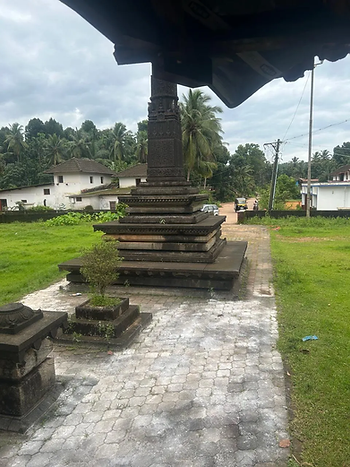
Panjurli is one amongst the Daivas, the spirits, which are worshipped by both Tulu Jains and Bunts in South Karnataka. Different forms of Panjurli are worshipped in the households of both Jains and Bunts. Represented in the form of a wild boar, Panjurli is believed to protect his devotees and the borders of Tulu Nadu. Last week, prodded me to visit one of the Jain Aramanes close to Udupi, the Kuthyar Aramane. Having heard from my relatives of how one of our girls was married to the Aramane then, and having read Pattanaik’s book, my curiosity was to find out how these homes survived over the years. One of the prominent houses associated with the Bunt community is a royal house; I was impressed and fascinated by the efforts taken by the family to preserve the royal house. As Jain Kings, they had coronations, responsibilities and married royal houses. From one Aramane to another, I could visualise how my ancestor would have adapted herself to live in these royal houses. And to have travelled from Aladangady Aramane to this place. As I walked through the passage towards the place where the spirits were kept, the throne reminded me of the royalty of these Arasas or Kings. Outside were the banas, or the snakehills and the worship of the cobras was evident. The guthu homes and the Aramanes had more or less the same architecture, and the royalty was immemorial. Remembered the stories of Abakka Chowta, the queen, whose spirit and bravery speak volumes of the warrior women of South Karnataka as I walked away from the serenity of the Aramane, stories lingered longer, the enigma continues, and the disconnected dots from Pattanaik’s book to the exact origins of the Jains in South Karnataka continues to invade my thoughts…..


Comments